Recently, leveraging high-level platforms such as the Shanghai High-level Local University Innovation Team for "Optoelectronic Detection Materials and Devices" and the Shanghai Engineering Technology Research Center for Optoelectronic Detection Materials and Devices, and with funding from the National Key Research and Development Program and key projects of the National Natural Science Foundation of China, the team of Professor Yongzheng Fang and Associate Professor Jingshan Hou from the Faculty of Materials Science and Engineering at Shanghai Institute of Technology has made significant progress in pressure-sensitive luminescent materials and devices. The relevant achievements have been published in Device, a sister journal of Cell, and Nature Communications, a subsidiary of Nature.
Pressure-sensitive luminescent materials have critical application value in fields such as aerospace, deep-sea and deep-earth engineering, high-pressure manufacturing, and major equipment. Extreme environments, such as high pressure and high temperature, impose higher demands on the luminescent stability and response reliability of materials.
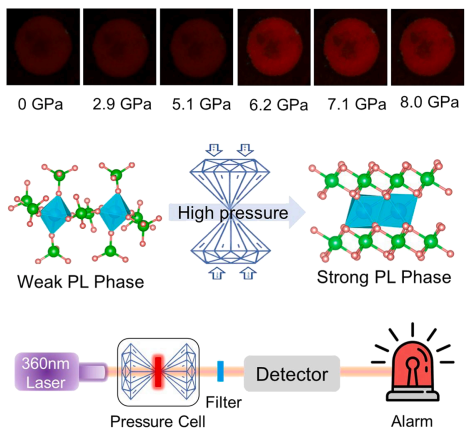
In the field of high-pressure luminescence and pressure sensing, the research team, in collaboration with the Center for High Pressure Science and Technology Advanced Research (HPSTAR), developed rare-earth-doped luminescent materials with anomalous pressure quenching characteristics based on a zero-thermal-expansion lattice. Under extreme conditions of 7.2 GPa, this material exhibited a sevenfold enhancement in luminescence compared to normal pressure. The team further developed an optical pressure alarm device. The related findings were published in Device under the title "High-pressure sensing using zero-thermal expansion phosphor with anti-quenching behavior" (2025 4, 101020; https://doi.org/10.1016/j.device.2025.101020).
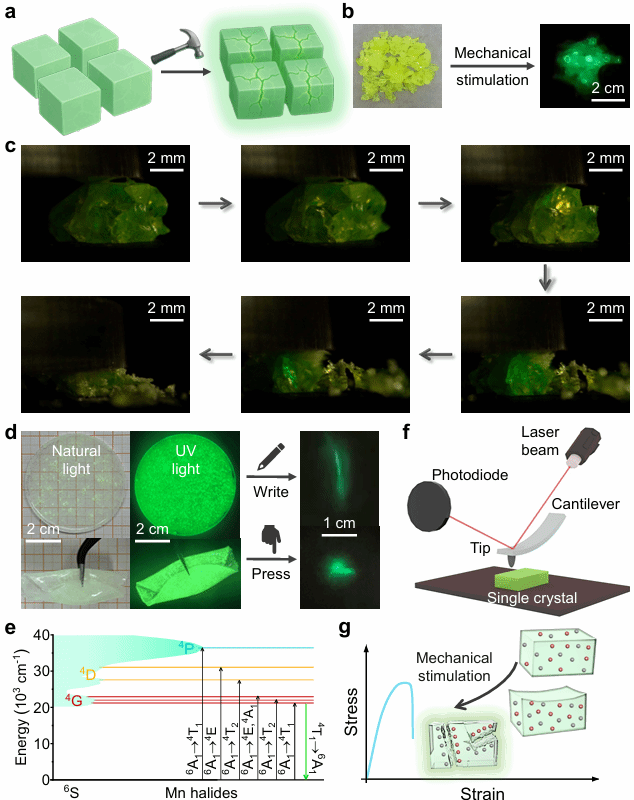
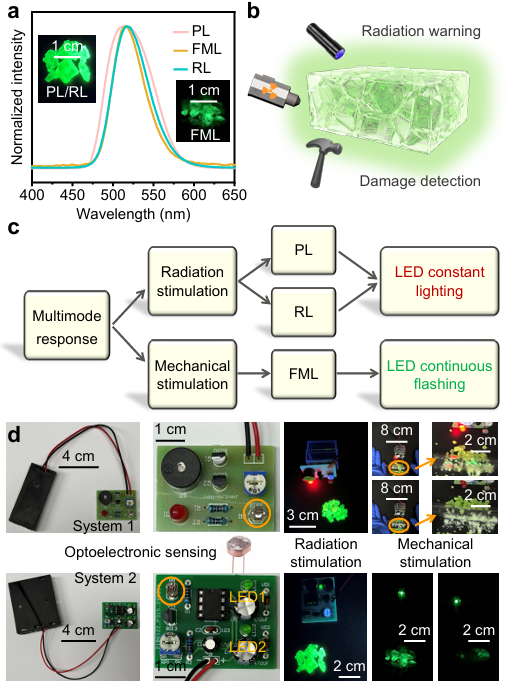
Fracto-mechanoluminescence (FML) is a phenomenon of light emission triggered by the fracture of solids under mechanical stimulation. As a subtype of mechanoluminescence, although various materials have been reported to exhibit this characteristic, the underlying mechanism remains unclear. The research team, in collaboration with Donghua University, China University of Geosciences (Wuhan), and the Shanghai Institute of Ceramics, Chinese Academy of Sciences, conducted studies on manganese halide-based luminescent materials. They revealed that the generation of FML originates from the synergistic effects of crystal elastic stiffness, local electromechanical coupling, and trap states. Additionally, the studied manganese halide materials demonstrated excellent X-ray imaging performance, and devices integrating radiation warning and damage detection were further developed. The related findings were published in Nature Communications under the title "Mechanistic insight into the Young’s modulus threshold for fracto-mechanoluminescence in manganese halides" (2026; https://doi.org/10.1038/s41467-025-67914-y).