Recently, relying on high-level platforms such as the Shanghai High-level Local University Innovation Team for "Optical Detection Materials and Devices" and the Shanghai Engineering Technology Research Center for Optical Detection Materials and Devices, and with funding from the National Key Research and Development Program and National Foreign Expert Projects, the research team led by Professor Fang Yongzheng from the School of Materials Science and Engineering has made significant progress in heterostructure luminescent materials. The research findings have been published in the internationally renowned top-tier journal Journal of the American Chemical Society (JACS).
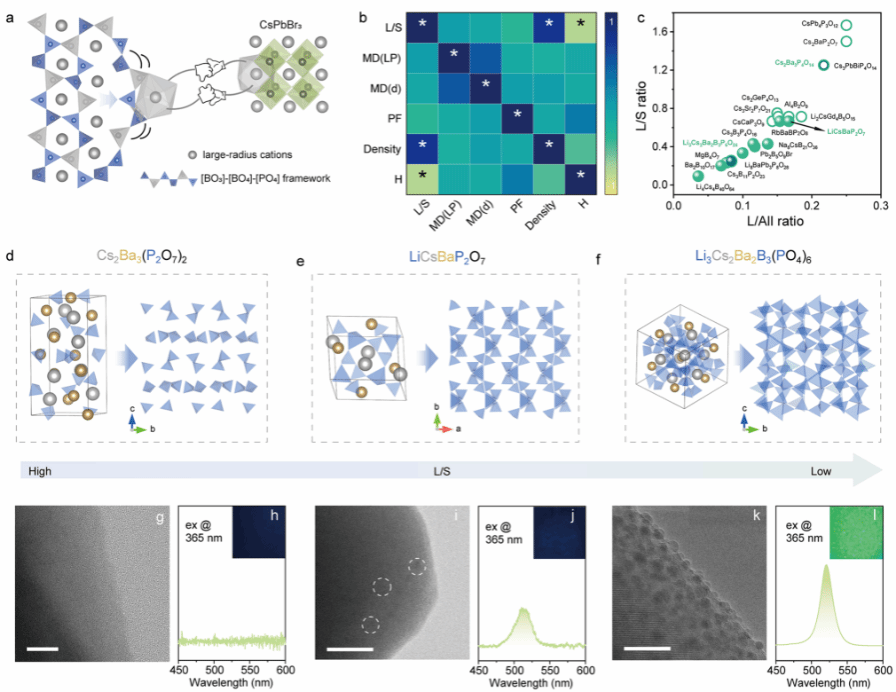
The development of heterostructures provides new insights for enhancing the performance of lead halide perovskite CsPbX₃ (X = Cl, Br, I) nanocrystals (NCs) in optoelectronic applications. Given the rich variety and high stability of oxide crystals, they have become promising candidates for integration with CsPbX₃ to expand their applications. However, due to severe lattice mismatch, constructing heterostructures by modifying CsPbX₃ with oxides remains a significant challenge.
In collaboration with Lanzhou University and City University of Hong Kong, the research team proposed a strategy: by rationally selecting matrix materials with structural adaptability, they constructed CsPbBr₃-oxide heterostructures with significantly mismatched lattice parameters. The study reveals that complex oxide crystals formed by an appropriate combination of large and small cations can withstand significant mismatch strain, thereby facilitating the epitaxial growth of dispersed CsPbBr₃ nanocrystals within the lattice.
Notably, the oxide matrix effectively protects CsPbBr₃ nanocrystals from water and thermal damage while enabling broader optical tunability through lanthanide doping. These findings provide important insights into the heterostructure engineering of functional materials and open up a new paradigm for the development and application of perovskite nanocrystal-based materials. The research results have been published in the Journal of the American Chemical Society under the title "Discovering Structure-Adaptive Oxides for Embedded Epitaxial Growth of Perovskite Nanocrystals" (2026, 148, 5, 5754–5763, https://doi.org/10.1021/jacs.5c22209).
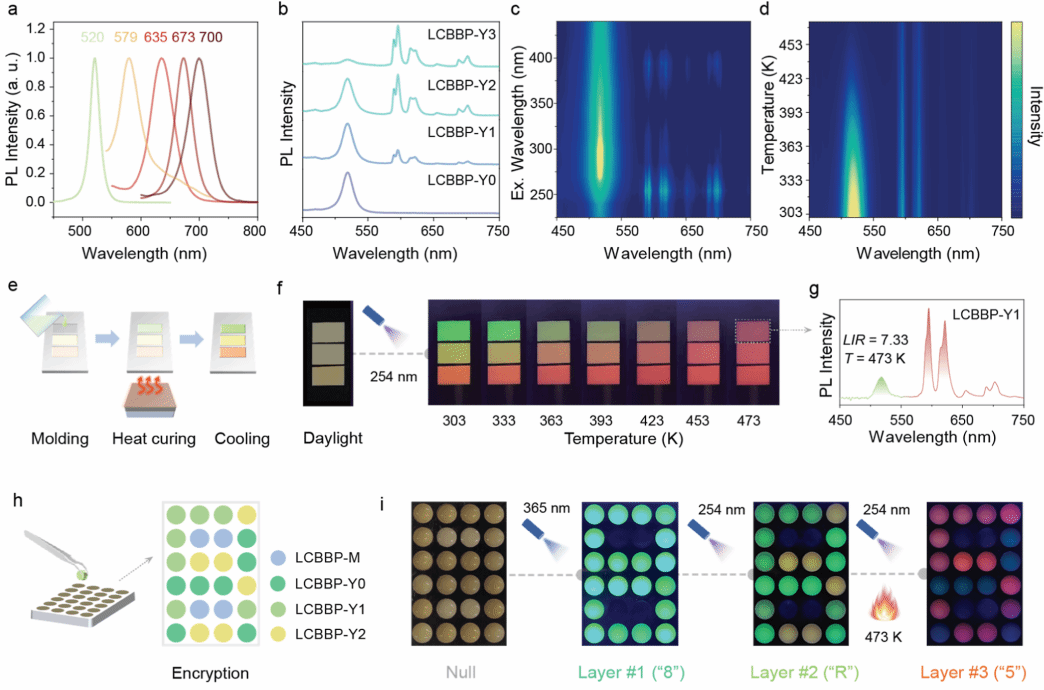
(Figure caption: Multi-color tuning of LCBBP-CPB. (a) PL spectra of LCBBP-CsPbX₃. (b) PL spectra of LCBBP-CPB under 254 nm excitation. (c) Excitation wavelength-dependent PL spectra of LCBBP-CPB containing 10% Eu at room temperature. (d) Temperature-dependent PL spectra of LCBBP-CPB containing 10% Eu under 254 nm excitation. (e) Schematic diagram of a colorimetric thermometer composed of synthetic materials. (f) Colorimetric temperature indication (303−473 K) under 254 nm excitation. (g) PL spectra of the sample marked by the dashed box in (f). (h) Schematic diagram of pixelated patterns composed of LCBBP materials for information encryption. (i) Decryption process based on three sets of photon output codes under different excitation/temperature parameters.)