Recently, relying on the Key Laboratory of Process Safety and Intelligent Control, the Institute of Beautiful China and Ecological Civilization, and the Faculty of Urban Construction and Ecological Technology, Professor Zhang Xiaoliang (corresponding author) from the Faculty of Urban Construction and Ecological Technology, Professor Mao Haifang (first author) from the Faculty of Fragrance and Flavor Science, and doctoral candidate Fang Jiawei (primary student author) published a paper titled “Thermal runaway behaviour induced by localised aluminium-water reaction at low temperature” in the Chinese Academy of Sciences (CAS) Q1 top-tier journal Chemical Engineering Journal (IF: 13.2).
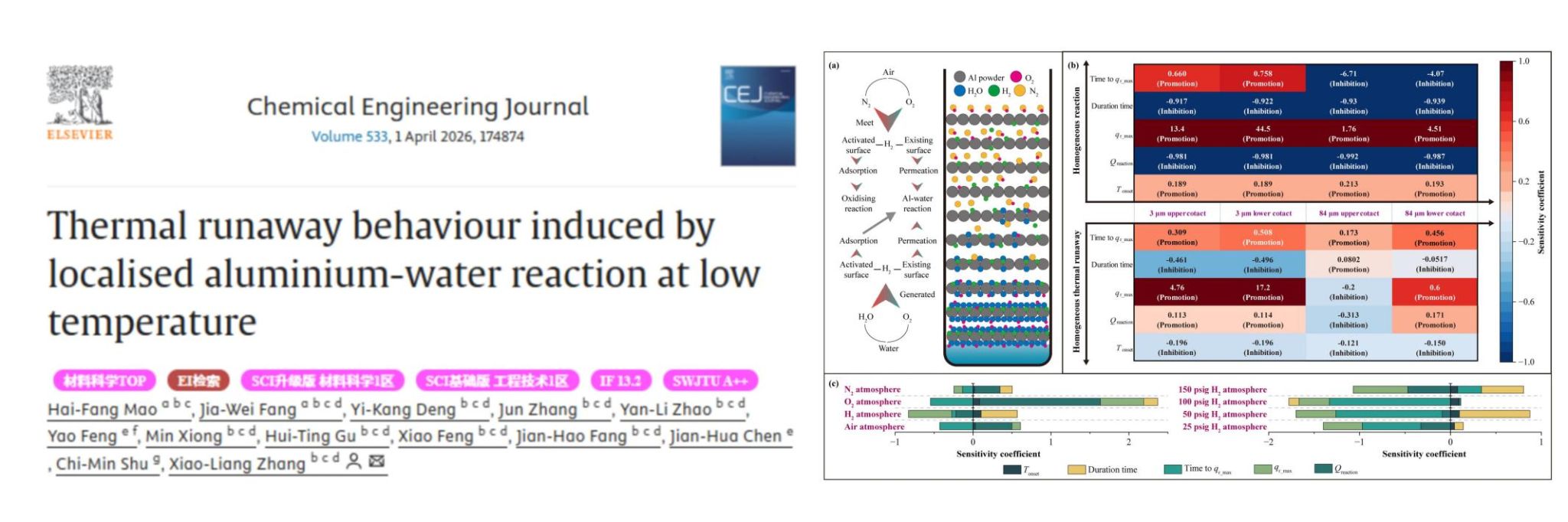
This study established a calorimetric method applicable to accumulated powder systems based on the temperature compensation method. It deeply analyzed the thermal runaway behavior induced by localized aluminum-water reactions in typical accident cases and constructed five key parameters for thermal runaway (onset temperature, heat release, maximum heat release rate, time to maximum heat release rate, and reaction time). For the first time, a systematic quantitative comparison of thermal hazards caused by localized aluminum-water reactions was conducted. The research findings provide critical insights and a quantitative basis for assessing and preventing thermal runaway risks during the storage and transportation of aluminum powder, marking a significant advancement of our university in the research fields of dust explosions and thermal runaway. (Original link: https://doi.org/10.1016/j.cej.2026.174874)
Since being designated as a key laboratory by the Shanghai Emergency Management Bureau, the laboratory has consistently focused on the cutting-edge directions of process safety and intelligent control. It has continuously deepened research in areas such as dust explosion prevention, reaction risk assessment, and thermal safety analysis, forming a research system that closely integrates fundamental research, technology development, and engineering applications. In the future, the laboratory will continue to leverage the university's advantageous disciplines, concentrating on research directions including dust explosion prevention, reaction safety, and intelligent control. It aims to promote the translation of original achievements and the deep integration of industry, academia, and research, thereby making greater contributions to enhancing safety technology levels in areas such as the development of new fine chemical processes, new drug R&D, and dust explosion prevention and control.