Recently, supported by high-level platforms such as the Shanghai Engineering Research Center of Photodetection Materials and Devices, and funded by the National Foreign Experts Program, the National Natural Science Foundation of China and the Shanghai Science and Technology Innovation Program, Professor Fang Yongzheng, Professor Hou Jingshan, Associate Professor Zhang Ganghua and their colleagues from the Industry-Education-Research Collaborative Education Team for Optoelectronic Information Materials and Devices have made important progress in the creation of high-precision optical thermometry materials and in the regulation of alkyl chains in two-dimensional molecular ferroelectrics.
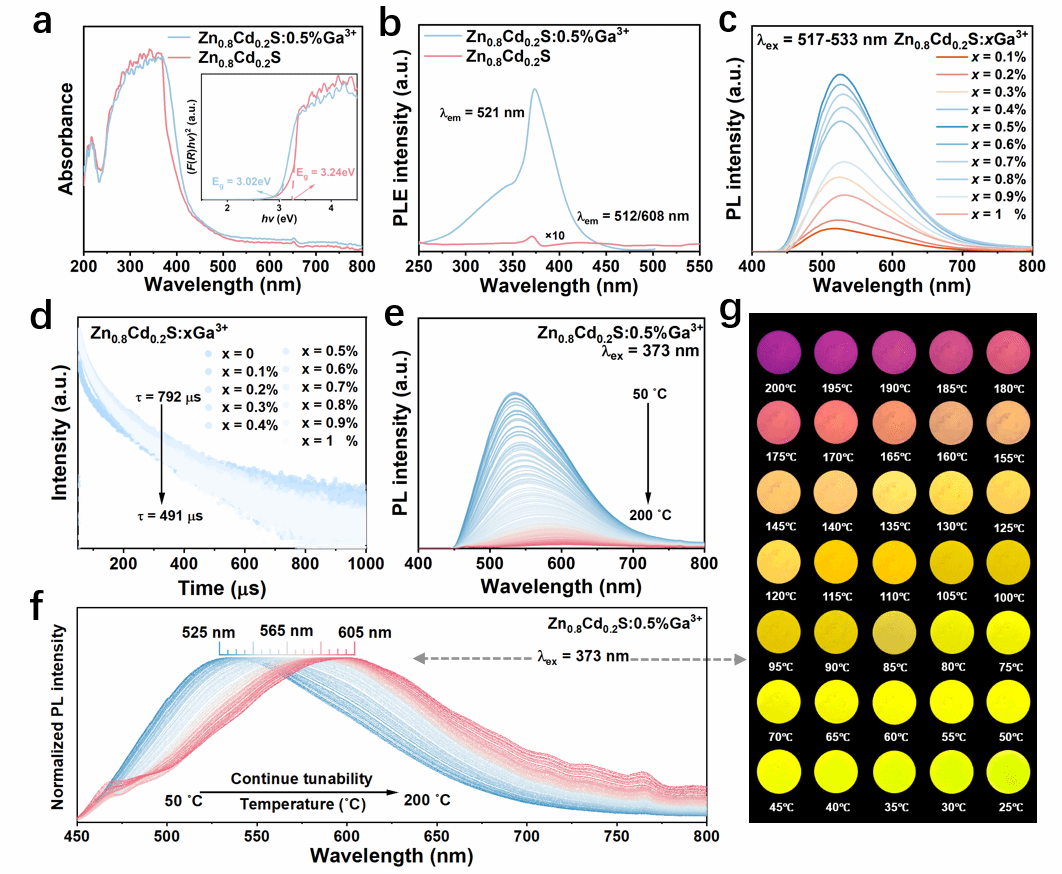
Multi-parameter thermal response characteristics of Zn0.8Cd0.2S:Ga3+
Optical thermometry has been described as the “nerve endings” of Industry 4.0 and high-end manufacturing. It is a core technology for ensuring the precise operation of high-end equipment, achieving accurate perception in extreme environments, supporting the digital transformation of intelligent manufacturing and meeting major national strategic needs. However, as high-end manufacturing becomes increasingly intelligent and precise, stricter requirements are being placed on key performance parameters such as the accuracy of optical thermometry devices, and the conventional thermometry mode that relies on a single optical parameter has exposed bottlenecks such as an obvious accuracy ceiling and susceptibility to disturbances in operating conditions.
The research team of SIT proposed a defect engineering strategy based on aliovalent ion doping, in which Ga3+ doping reconstructs the defect state distribution and energy level structure of the host material, successfully producing a highly efficient, broad-spectrum-emitting Zn0.8Cd0.2S:Ga3+ luminescent material. Over an ultra-wide thermometry range from −193 °C to 200 °C, the material exhibits a very strong temperature dependence, achieving simultaneous, continuous and highly sensitive thermal responses in three core optical parameters: luminescence intensity, full width at half maximum and emission peak position. Based on the spectral thermal response of the material, the team further developed a portable multi-channel fiber-optic optical thermometry sensor. The results were published under the title “Defect Engineering Enables High-Precision Optical Thermometry in Zn0.8Cd0.2S:Ga” in the top international journal Advanced Functional Materials (2026, e75726; https://doi.org/10.1002/adfm.75726; IF = 19).
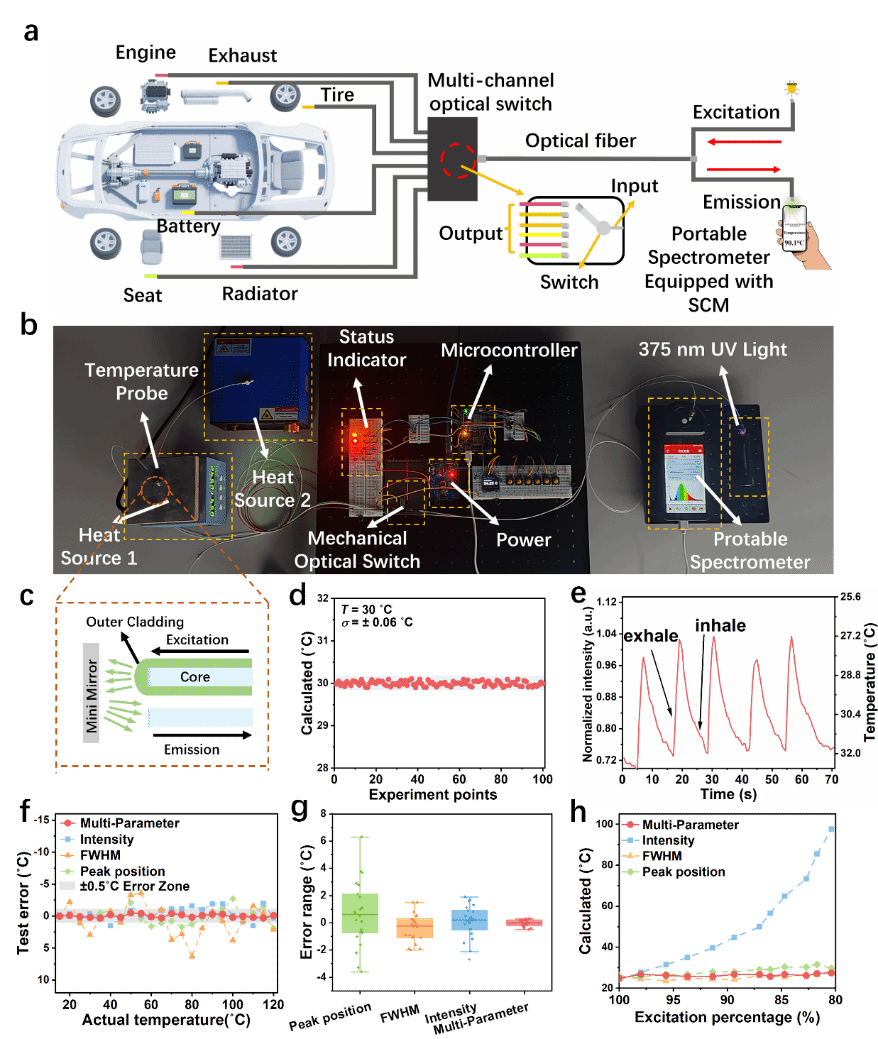
Construction of a portable thermometry system based on Zn0.8Cd0.2S:Ga3+
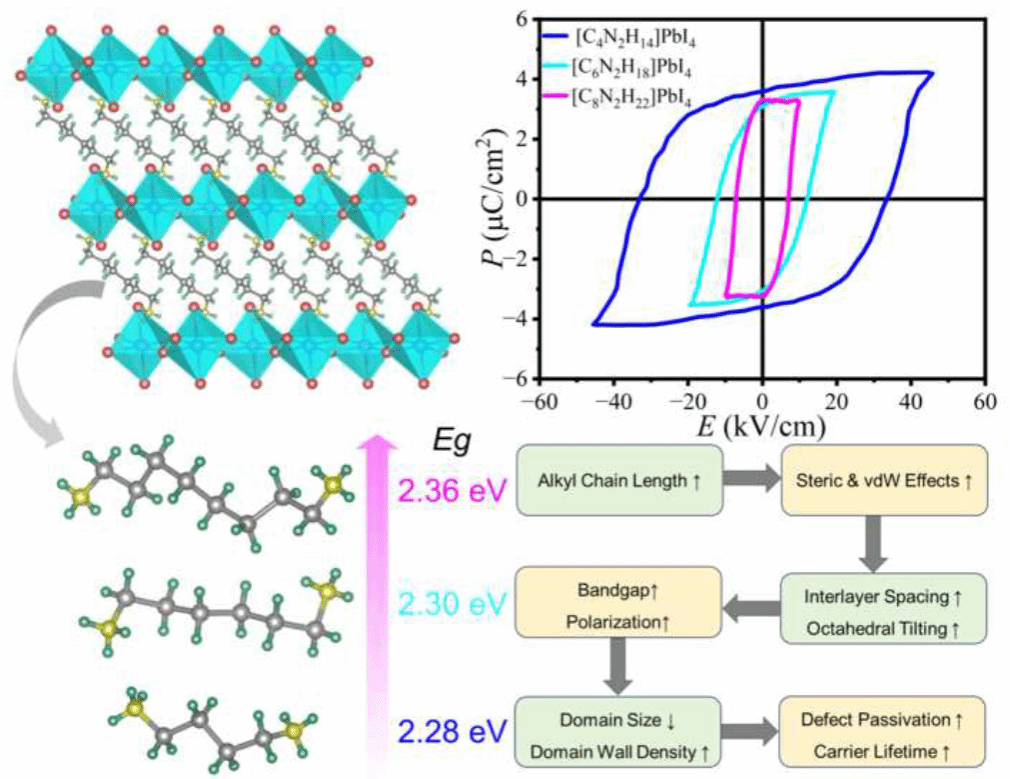
A new mechanism by which long-chain-induced nanoscale ferroelectric domains and enhanced van der Waals interactions synergistically improve photoelectric performance
Two-dimensional organic-inorganic hybrid molecular ferroelectrics, with advantages such as low cost, easy processing and tunable structures, show broad application prospects in self-powered optoelectronic devices, flexible electronics and smart sensing. However, the mechanism by which alkyl chain length systematically regulates the bandgap, ferroelectric and photoelectric properties of these materials remains unclear, which has constrained the rational design of molecular ferroelectrics.
The research team synthesized a new two-dimensional molecular ferroelectric, [C6N2H18]PbI4, by a hydrothermal method; it has a polar Pc space group, a direct bandgap of 2.30 eV and a room-temperature saturation polarization of 3.5 μC/cm2. By further comparing homologues with different alkyl chain lengths (C4, C6 and C8), the team established, for the first time, a complete causal chain linking interlayer spacing (10.42 Å → 13.80 Å), bandgap (2.28 eV → 2.36 eV), maximum polarization (3.9 → 3.2 μC/cm2) and photocurrent gain (13 → 60 times), revealing a new mechanism in which long-chain-induced nanoscale ferroelectric domains and enhanced van der Waals interactions work synergistically to improve photoelectric performance.
This work provides systematic theoretical guidance for optimizing the performance of two-dimensional molecular ferroelectrics and for the molecular design of self-powered optoelectronic devices. The related results were published under the title “Effect of Alkyl Chain Length on the Bandgap, Ferroelectric, and Photoelectric Properties of Lead-Based Molecular Ferroelectrics” in the top international journal Advanced Science (2026, https://doi.org/10.1002/advs.202518745).